

Many people in Newark are frustrated by difficulty getting GP appointments, long waits at the Urgent Treatment Centre (UTC), and uncertainty about where to turn when they feel unwell.
This guide explains the realistic options available, what each service is designed to deal with, and when it’s appropriate to use them. Choosing the right service can save you time, reduce stress, and help ensure emergency care is available for those who genuinely need it.
Important Note (Please Read)
This article provides general information only and does not replace professional medical advice.
If symptoms are severe, rapidly worsening, or you believe there is a risk to life, seek urgent medical help immediately. In an emergency, call 999.
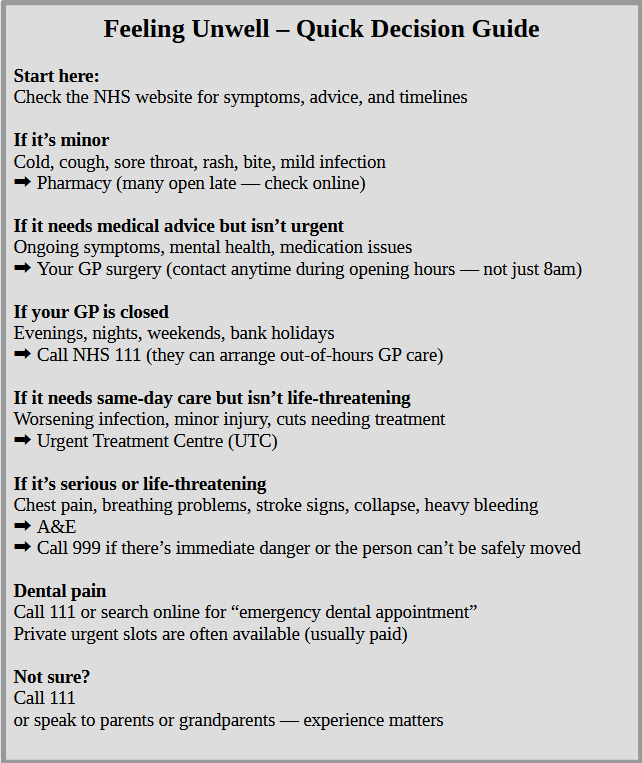
Start Here: The NHS website
For many illnesses, the NHS website should be your first stop.
It’s useful for
- Explaining symptoms and what’s normal versus concerning
- Clear timelines on when to self-care and when to escalate
- Practical advice on treatment and over-the-counter remedies
For common problems such as colds, flu, stomach bugs, sore throats, and minor pain, the NHS website often tells you exactly what to do and when to worry.
GP Surgeries (Doctors & Practice Nurses)
Your GP surgery is the right place for non-urgent but important medical issues.
Appropriate for
- New or ongoing health concerns that aren’t emergencies
- Long-term conditions, medication reviews, and referrals
- Mental health concerns and fit notes
No more “8am scramble”
Under current NHS rules, GP surgeries are no longer allowed to rely on a single 8am rush for appointments.
Instead:
- You can contact your surgery throughout core opening hours
- Requests must be assessed the same day
- You should receive advice, an appointment, or signposting
Most surgeries operate Monday to Friday, roughly 8am–6:30pm (check your surgery’s exact hours).
You may be offered an appointment with:
- A GP
- A practice nurse
- Another trained clinician
- By phone or online
Not every issue needs a GP specifically.
👉 You can find a list of Newark GP surgeries here: GP Surgeries in Newark
Out-of-Hours GP Appointments
If you need medical help in the evening, overnight, at weekends, or on bank holidays, support is still available.
- Call NHS 111
- They can arrange out-of-hours GP services when appropriate
- This is the correct route — do not attend A&E just because your GP is closed
📞 Call 111 or use the NHS online service
Community Pharmacies
Pharmacies are often the fastest and most appropriate option for many conditions and are widely underused.
They can help with
- Common illnesses such as coughs, sore throats, rashes, bites, and minor infections
- Medication advice, side-effects, and supply issues
- Some vaccinations, without needing to see a GP
Also worth knowing
- Some pharmacies open late evenings or weekends
- Opening times vary — check online before travelling
Pharmacists are highly trained clinicians and can often save you a GP or UTC visit entirely. You can find a list of pharmacies in the Newark area here: Newark Pharmacies
Urgent Treatment Centres (UTCs)
UTCs are for urgent but non-life-threatening problems that need same-day attention.
Appropriate for
- Injuries or illnesses needing treatment today
- Worsening symptoms when GP appointments aren’t available
Important
- UTCs are not A&E
- Long waits often reflect people attending with minor conditions that could be treated elsewhere
A&E – For Emergencies Only
Accident & Emergency is for serious or life-threatening conditions.
Go to A&E for
- Chest pain or suspected heart attack
- Severe breathing problems
- Signs of stroke (face drooping, arm weakness, speech problems)
- Serious injuries, collapse, or loss of consciousness
A&E is not appropriate for minor illness, long-standing pain, or problems better handled by GPs, pharmacies, or UTCs.
Ambulances: When to Call 999
Call 999 if there is an immediate risk to life or if the person cannot be safely moved.
Examples include
- Suspected heart attack or stroke
- Severe breathing difficulties
- Major trauma or serious injury
- Heavy, uncontrollable bleeding
- Collapse where the person cannot get up
If someone can safely travel by car or taxi, an ambulance is usually not appropriate.
In many areas, people are now advised — and sometimes supported — to make their own way to hospital when an ambulance is not clinically required, so emergency crews remain available for life-threatening cases.
Workplace Health Schemes & Private GP Access
Many people don’t realise their employer may already offer:
- Private GP phone or video appointments
- Same-day consultations
- Prescriptions and referrals
Some private health insurance policies include similar services. It’s worth checking your HR benefits or policy documents.
Dental Problems: Limited, But There Are Options
Access to NHS dentists is difficult, but urgent dental care does exist.
Your options
- Call NHS 111 for urgent NHS dental services
- Search online for “emergency dental appointment” to see dentists in your area offering urgent slots
- Private emergency appointments are often available next day, though fees (typically £80–£120) are common
Pharmacists can also advise on temporary pain relief and infection control.
Severe dental pain should not be ignored — infections can spread.
Experience Still Matters: Parents and Grandparents
If you’re unsure — especially if you live away from home — ask your parents or grandparents.
They’ve seen:
- Common childhood and adult illnesses
- What usually passes on its own
- What tends to need medical attention
A calm, experienced second opinion can prevent unnecessary panic — or prompt you to act sooner when it matters.
Final Thought
The NHS works best when each service is used for what it was designed to do.
Knowing your options — and using them appropriately — helps you get the care you need more quickly, while keeping emergency services available for those who truly need them.